How to read a certificate of analysis
Understand the role of lot identifiers, analytical methods, purity results, and third-party documentation when reviewing a batch.
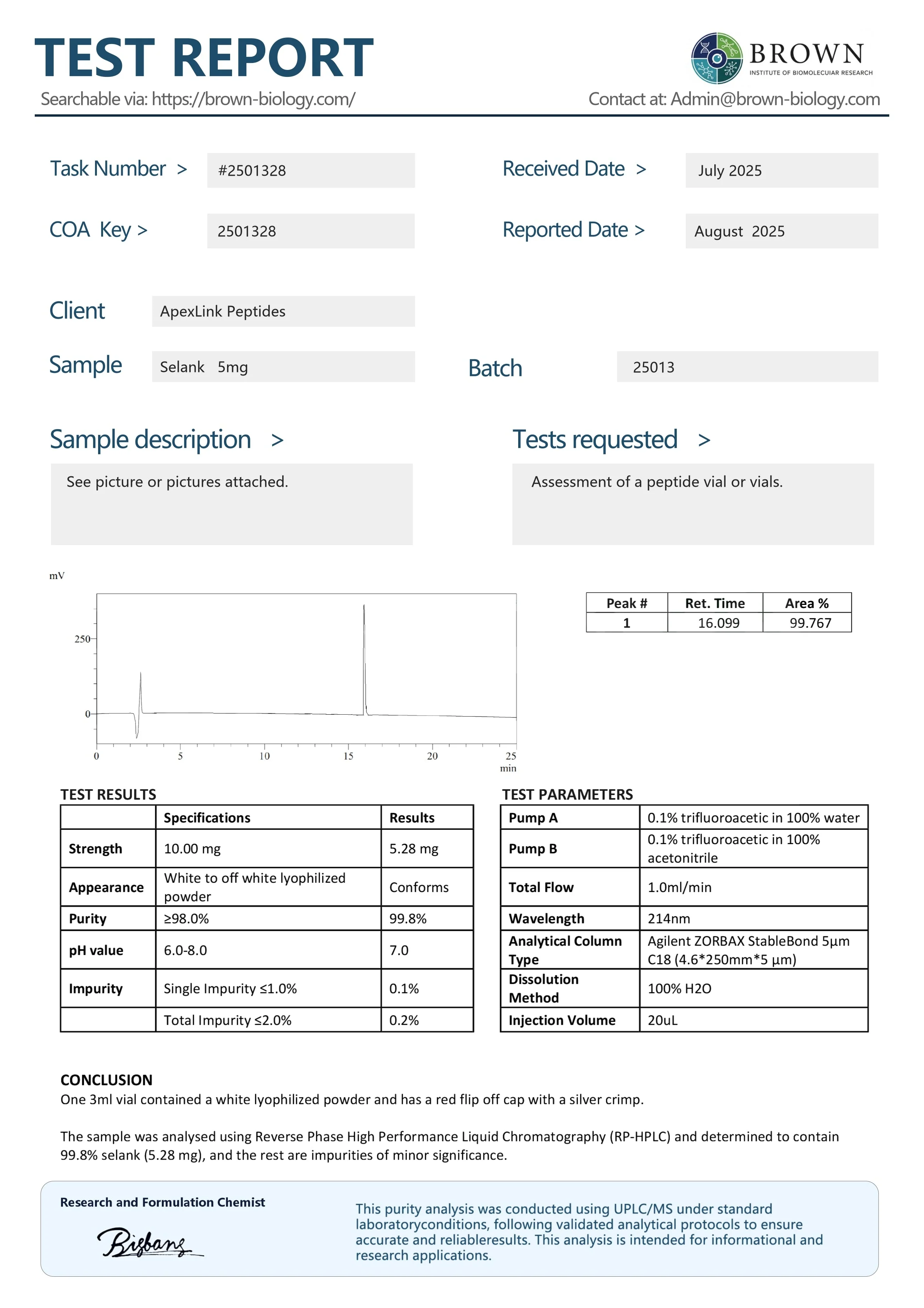
Start with batch identity
The lot or batch identifier should match the physical product being reviewed. This connection is essential: a result without a clear sample identity cannot provide meaningful traceability.
Understand the method
A certificate should identify the analytical method used and the result it supports. HPLC is commonly used to assess purity, while other methods may address identity, quantity, or additional quality attributes.
Purity is not the same as identity
Chromatographic purity commonly describes the relative area associated with a principal peak under defined test conditions. It can be useful for estimating the proportion of detected components, but a large principal peak alone does not prove that the peak is the intended molecule.
Identity is typically supported by an orthogonal technique, such as mass spectrometry, that evaluates a different molecular property. Reading both results together provides more information than treating either as a complete answer.
Read chromatograms in context
A chromatogram plots detector response over time. Retention time, integration boundaries, detector settings, gradient conditions, and sample preparation all influence how the trace is interpreted.
Minor peaks may represent impurities, degradants, solvent-related signals, or method artifacts. Their significance depends on the method and cannot be determined from peak count alone.
Check dates, laboratory, and sample chain
Testing dates help establish when the analysis occurred relative to production and release. Laboratory identity and report references make the result traceable to the organization that performed the work.
When available, sample receipt information, condition on arrival, and report identifiers strengthen the connection between the submitted material and the published certificate.
Review the complete record
Read the result alongside the test date, laboratory details, and any supporting chromatograms or notes. No single number should be interpreted without its surrounding documentation.